


The Cavity Nobody Sees Coming
The back teeth the molars have deep grooves and pits on their biting surfaces that are the most common site for childhood cavities. These grooves are so narrow that a single toothbrush bristle cannot enter them. Food and bacteria accumulate there day after day, and decay begins long before it is visible.
Pit and fissure sealants can solve this problem. Sealants are thin and flowable resin material applied to the grooved surfaces of the back teeth, physically sealing them off from food and bacteria. No drilling. No injections. No discomfort. Just protection applied in minutes, lasting for years.
What Are Pit and Fissure Sealants?
Pit and fissure sealants are thin, tooth coloured resin or glass ionomer coatings that are flowed into and bonded onto the grooves (fissures) and pits on the chewing surfaces of molar and premolar teeth. Once cured with a light, they form a hard, smooth protective barrier over the most cavity prone surfaces of the tooth.
Think of it as painting a protective layer over a surface that would absorb stains. The grooves that once trapped bacteria are now covered by a seamless, cleanable surface that a toothbrush can sweep clean with every stroke.
What sealants do, simply put:
- Physically block bacteria and food from entering the deep grooves of back teeth.
- Create a smooth, flat surface that is easy to clean with normal brushing.
- Eliminate the primary site of cavity formation in children and teenagers
Why Are Back Teeth So Vulnerable to Cavities?
Smooth tooth surfaces like the front teeth can be swept clean by a toothbrush relatively easily. The back tooth is the first permanent tooth to erupt in the oral cavity. Other reasons include
- Deep, narrow fissures: The chewing surfaces of molars and premolars contain pits and grooves that can be 0.1 to 1.5 mm deep far narrower than the width of a single toothbrush bristle (0.2 mm or more). Bacteria that settle into these grooves are mechanically protected from brushing.
- Prolonged eruption period: As a molar erupts through the gum over several months, the partially erupted surface sits at gum level and accumulates plaque continuously. This is one of the highest risk periods for cavity formation on that tooth
- Occlusal surface loading: The biting surface where the grooves are is also where most chewing force is applied. Food is repeatedly packed into the fissures during every meal
- Children’s brushing limitations: Back teeth are difficult to reach and require careful technique to clean effectively. Children under 8 to 9 years old simply do not have the motor coordination to do this reliably, even with daily supervision
The result: Extensive evidence supports sealants as an effective intervention for both preventing caries and arresting non cavitated lesions. One study in children demonstrated a 37% reduction in caries risk with pit and fissure sealants compared to a control group. Another study found that, over a 3 year period, first permanent molars treated with sealants showed a 44% lower risk of developing caries compared to untreated teeth.
Liu W, Xiong L, Li J, Guo C, Fan W, Huang S. The anticaries effects of pit and fissure sealant in the first permanent molars of school age children from Guangzhou: a population based cohort study. BMC Oral Health. 2019 Jul 16;19(1):156.
Who Should Receive Pit and Fissure Sealants? Clinical Indications
Sealants are beneficial for all children, but are particularly strongly indicated in the following clinical situations. These indications are aligned with standard paediatric dental guidelines including the principles outlined by the International Association of Paediatric Dentistry (IAPD):
Newly Erupted Permanent Molars: The Primary Indication
The optimal window for sealant placement is immediately after a molar has fully erupted typically within the first 12 to 18 months of eruption. During this period, the enamel is not yet fully mineralised, the grooves are most vulnerable, and the decay risk is at its highest. Sealing at this stage provides protection at the most critical time.
Deep Pit and Fissure Morphology
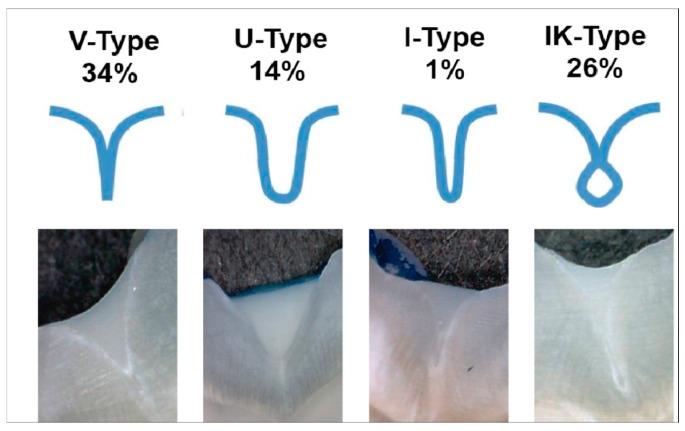
Not all molar grooves carry the same risk. The morphology of the occlusal surface of the molars is extraordinarily variable. Occlusal fissures are deep invaginations of enamel that can be extremely diverse in shape and have been described as broad or narrow funnels, constricted hourglasses, and multiple invaginations with inverted Y shaped divisions and irregularly shaped. We will assess fissure depth and morphology at the check up and recommend sealants where the structural risk is elevated.
High Caries Risk Children
- Previous history of cavities: Children who have already experienced tooth decay are statistically at significantly higher risk of future cavities. Sealants are strongly indicated to protect as yet unaffected molar surfaces
- Frequent snacking or high sugar diet: Repeated acid exposure from sugary snacks and drinks increases the risk of decay in vulnerable grooves
- Poor or developing oral hygiene: Children who struggle to maintain consistent plaque removal benefit substantially from the mechanical protection sealants provide
- Reduced salivary flow: Saliva plays a crucial protective role in neutralising acid and remineralising enamel. Children with reduced salivary function are at elevated risk and benefit from additional physical protection
Orthodontic treatment:
Fixed braces create multiple food trap areas and make thorough brushing more challenging. Molar surfaces under and around orthodontic bands are particularly vulnerable. Sealant placement before banding, where clinically feasible, reduces decay risk during treatment.
Children with Special Healthcare Needs
Children with medical conditions, developmental disabilities, or behavioural challenges that affect oral hygiene maintenance are at elevated cavity risk. Sealants provide a degree of passive protection that supplements whatever home care is possible.
Primary (Baby) Teeth in Selected Cases
Although sealants are primarily applied to permanent molars, primary molars with deep fissure morphology in high risk children may also be sealed. This is particularly relevant when the primary molar will remain in the mouth for several more years and the child has a documented high cavity risk.
Age Wise Sealant Recommendations: A Clear Guide for Parents
The timing of sealant placement is guided by tooth eruption schedules. Here is a simple, age by age guide:
Around Age 6 First Permanent Molars
Teeth: First permanent molars (upper and lower, behind the last baby tooth)
When to seal: As soon as they have fully erupted and can be isolated from saliva typically between age 6 and 7
Why it matters: These are the most important teeth in the mouth for chewing function. They erupt early and are often mistaken for baby teeth by parents. Losing them to decay at a young age has lifelong consequences for the bite.
Around Age 11-12 Second Permanent Molars
Teeth: Second permanent molars (upper and lower, erupting behind the first molars)
When to seal: As soon as fully erupted, typically between age 11 and 13
Why it matters: The second molars erupt during early adolescence, a period of dietary independence and sometimes inconsistent oral hygiene. Sealing them at eruption provides protection during the highest risk window.
Premolars if Indicated
Teeth: Upper and lower premolars (replacing back baby teeth, erupting age 9-11)
When to seal: When deep fissure morphology is present or in high risk children
Why it matters: Premolars sometimes have deep central grooves that benefit from sealing, particularly in children with a history of cavities.
Primary Molars in Selected High Risk Cases
Teeth: Baby molars with deep grooves in high risk children
When to seal: When fissure depth is clinically significant and cavity risk is documented as high
Why it matters: A case by case decision made by your dentist based on the individual child’s risk profile.
Sealants vs Fluoride: Different Tools, Both Essential
Parents often ask whether sealants and fluoride are alternatives. They are not, they are complementary tools that protect teeth through completely different mechanisms, and together they provide significantly better protection than either alone.
| Feature | Pit & Fissure Sealants | Fluoride Treatment |
|---|---|---|
| How it works | Physical barrier, seals grooves from bacteria and food | Chemical strengthening, hardens enamel, reverses early decay |
| Where it protects | Specifically the pits and fissures of molar/premolar chewing surfaces | All tooth surfaces, including smooth surfaces and between teeth |
| What it prevents | Occlusal (groove) cavities, the majority of cavities in children | Smooth surface cavities, early demineralisation, white spots |
| How it is applied | Bonded resin or glass ionomer coating; cured with light | Varnish painted on teeth, or fluoride gel in a tray |
| Duration | 2-5 years with regular monitoring; reapplied as needed | Effects last 3-6 months; reapplied at each preventive visit |
| Pain / discomfort | None, no drilling, no injection | None, quick brush application |
| Replaces each other? | ✗ No, sealants do not replace fluoride | ✗ No, fluoride does not replace sealants |
| Used together? | ✓ Yes, best results when both are used consistently | ✓ Yes, best results when combined with sealants |
The combined prevention approach:
Sealants block the grooves where 80-90% of cavities start. Fluoride strengthens all enamel surfaces and reverses early damage. Together, they provide nearly comprehensive protection against childhood tooth decay.
The Sealant Procedure: No Drilling, No Pain, No Fear
This is one of the easiest procedures in paediatric dentistry. There is no drilling, no injection, and no discomfort. Most children are completely at ease throughout, and many find it quick and unremarkable.
STEP 1 Cleaning the tooth surface
The chewing surface of the tooth is gently cleaned to remove any plaque or debris. This is done with a small brush or air water spray no instruments that enter the groove, and no sensation of discomfort.
STEP 2 Drying and isolating the tooth
The tooth surface is dried thoroughly with air. Keeping the surface dry during application is important for a good bond. Cotton rolls or a rubber dam may be used to protect the area from saliva. This takes only a few seconds.
STEP 3 Etching the tooth surface
A mild acid gel (etching solution) is applied to the grooved surface for 15 to 30 seconds and then rinsed away. This creates a slightly rougher surface at a microscopic level that helps the sealant bond strongly to the enamel. Your child may feel a mildly sour taste briefly nothing more.
STEP 4 Flowing the sealant material
The liquid sealant material is carefully flowed into the grooves using a small applicator tip. It flows into every part of the fissure by capillary action, filling the spaces where bacteria would otherwise accumulate.
STEP 5 Curing with a dental light
A bright blue light is held over the sealant for 20 to 40 seconds. This activates a chemical reaction that hardens the material almost instantly. The light is completely harmless.
STEP 6 Bite check and polish
Your child bites gently on carbon paper to check that the sealant does not create any high spot in the bite. Any minor adjustments are made in seconds. The surface is polished smooth. The tooth is now protected.
Total chair time: 5 to 15 minutes per tooth. No local anaesthesia. No drilling. Children are free to eat and drink normally after the appointment (avoiding hard, sticky foods for the first few hours).
How Long Do Sealants Last? What to Expect
Pit and fissure sealants are durable but not permanent. Their longevity depends on the material used, the child’s bite forces, dietary habits, and how well the bonding was performed at placement.
- Expected lifespan: With proper care and regular monitoring, sealants typically last 2 to 5 years. Some remain intact for longer. The important point is regular check up monitoring
- Why they are checked at every visit: Sealants can partially chip or wear over time, particularly in children with heavy bite forces or a habit of chewing hard objects. A partially worn sealant may no longer seal the groove completely
- Reapplication: If a sealant has worn or chipped, it can be easily reapplied at a routine check up appointment again, with no drilling and no discomfort
- Early detection: Even if a sealant has partially worn away, regular monitoring allows us to catch any early decay at the earliest, most treatable stage
The key message: sealants work best as part of a regular preventive programme. A child who receives sealants and then does not attend check-ups loses the monitoring benefit. Six monthly check ups are required every 6 months to ensure sealants are assessed and reapplied as needed to keep up with the protection of the tooth.
Preventive Dentistry at Mohan Dental Clinic:The Complete Protection Plan
Sealants are one component of a structured preventive programme at Mohan Dental Clinic. When combined with the other elements of our paediatric prevention plan, they provide the most comprehensive protection against childhood cavities available.
- Regular Biannual check ups: Monitoring of sealant integrity, cavity risk assessment, early decay detection, and developmental guidance at every visit
- Pit and fissure sealants: Applied to all eligible molar and premolar surfaces as they erupt, sealed at the optimal window
- Professional fluoride treatment: Applied at every check up visit, providing the complementary enamel strengthening protection that sealants do not provide
- Oral hygiene instruction: Age appropriate brushing and flossing technique demonstrated and reinforced at every visit
- Dietary counselling: Practical guidance on snacking frequency, drink choices, and sugar exposure that reduces overall cavity risk
- Interceptive orthodontic monitoring: Early identification of alignment and jaw development issues that, if addressed early, prevent more complex treatment later
Our goal is straightforward: we want your child to reach their teenage years with all their permanent teeth intact, healthy, and cavity free. Every element of this programme serves that goal.
Common Parental Questions about Sealants: Answered Honestly
“Are sealants safe? I’ve heard they contain BPA.”
✅ Modern dental sealant materials are rigorously safety tested and approved by international dental and health authorities. Some resin based sealants historically contained trace amounts of bisphenol-A (BPA) or BPA derivatives. However, a report by the American Dental Association and the American Academy of Pediatric Dentistry did not support the occurrence of adverse effects after sealant placement and described the BPA effect as a small transient effect. If you have specific concerns about the material we use, we are happy to discuss it in detail at your consultation.
“Do sealants damage or weaken the tooth?”
✅ No. Sealant placement involves no removal of tooth structure whatsoever. The mild etching step creates microscopic surface roughness at the enamel level the enamel itself is not drilled, cut, or reduced in any way. When a sealant is later removed or worn away, the tooth is structurally identical to before it was sealed. Sealants protect the tooth; they do not alter it.
“My child has no cavities, do they really need sealants?”
✅ This is exactly the right time to apply sealants. Sealants are a preventive treatment, they work by preventing cavities from forming in the first place, not by treating them after they have formed. A cavity free first molar that is sealed will remain cavity-free on the filled area in most of the cases. Waiting until a cavity develops means the tooth now needs a filling rather than a sealant. Prevention is always simpler, less expensive, and less distressing than treatment.
“Can bacteria get trapped under the sealant?”
✅ This concern is well understood clinically. When a sealant is placed over a groove that contains a small amount of bacteria, those bacteria are sealed in without access to oxygen, nutrients, or sugar. Studies have shown that bacteria trapped under an intact, well placed sealant do not progress to cavities because their food supply is cut off. The critical requirement is that the sealant remains intact and fully sealed which is why regular monitoring at check ups is essential.
Benefits of Pit and Fissure Sealants
- Up to 80% reduction in occlusal cavities: Clinical evidence consistently shows that sealed molar surfaces have dramatically lower cavity rates than unsealed surfaces
- Protects the hardest to clean areas: The deep fissures that no toothbrush can reach are physically sealed off, removing the most common site of cavity formation
- Pain free and non invasive: No drilling, no injections, and no anxiety. One of the easiest preventive procedures available in paediatric dentistry
- Cost effective: The cost of a sealant is a fraction of the cost of a filling, a crown, or a pulp treatment. One sealant can prevent multiple future treatments on the same tooth
- Long lasting protection: A single application protects the tooth for 2 to 5 years, with easy, inexpensive reapplication at check ups if needed
- Supports overall development: Cavity free back teeth allow children to chew all foods comfortably, supporting proper nutrition and jaw development
Why Families Choose Mohan Dental Clinic for Sealants in Kondapur
Prevention as a Priority
Sealants are not an add on at our clinic, they are a core part of how we care for children’s teeth. Every newly erupted molar is assessed for sealing at the check up when it becomes eligible. We do not wait for a parent to ask.
Precise, Protocol Driven Application
The quality of a sealant depends entirely on how well it is placed: the surface must be completely dry, the etching adequate, and the material fully flowed into the fissure. Our team follows evidence based placement protocols at every application, maximising the longevity of every sealant we place.
Child Friendly Approach
We explain the procedure to children in friendly, age-appropriate language before we begin. Most children are curious rather than anxious once they understand that there is no drilling and no injection involved. We move at the child’s pace and ensure every visit is a positive one.
Part of a Complete Preventive Programme
Sealants placed here are not a one-off procedure. They are part of a monitored preventive programme that includes regular check-ups, fluoride application, dietary guidance, and parent education. Protection is continuous, not episodic.
Complete Preventive Care at Mohan Dental Clinic
→ Fluoride Treatments for Kids in Kondapur
→ Pediatric Dental Check-Ups in Kondapur
→ Preventive Dental Care for Children - Complete Programme
Protect Your Child’s Teeth before Cavities Begin
The best dental visit your child can have is one where nothing needs to be treated, because everything has been prevented. Pit and fissure sealants are one of the most effective steps you can take towards that outcome.
If your child is approaching age 6, has recently had a new molar erupt, or has not yet had their molars assessed for sealing, this is the right time to act. Contact our team at Mohan Dental Clinic in Kondapur and we will schedule a preventive check up at your earliest convenience.
FAQs
When should my child get sealants?
The ideal time is as soon as each molar has fully erupted and the surface can be kept dry for the application. For the first permanent molars, this is typically between age 6 and 7. For the second permanent molars, between age 11 and 13. We assess every check up whether the newly erupted tooth is ready for sealing and recommend it immediately when it is. The sooner after eruption, the better.
Are sealants better than fluoride for cavity prevention?
They are not better or worse, they are different. Sealants are a physical barrier that specifically protects the grooves on chewing surfaces. Fluoride is a chemical treatment that strengthens all enamel surfaces. Studies show that combining both provides significantly better protection than either alone. We provide both as part of our standard preventive programme.
How long do sealants last?
Typically 2 to 5 years, though some last longer. Longevity depends on the child’s bite forces, dietary habits, and how well the sealant bonded at placement. We check sealant integrity at every six month checkup. If a sealant has worn or partially chipped, it can be reapplied quickly and without discomfort at the same appointment.
Is the procedure painful?
No. there is no pain and no discomfort during sealant placement. There is no drilling and no injection. The mildly sour taste of the etching solution lasts only a few seconds. The bright curing light is harmless. Most children tolerate the procedure with no distress. It is genuinely one of the easiest and most comfortable things we do in the dental clinic.
Do adults and teenagers need sealants?
Teenagers can benefit from sealants, particularly when second permanent molars are newly erupted, or in older teenagers with previously unsealed first molars that remain cavity free. Adults with deep fissure morphology and no existing restorations in those areas can also benefit. Your dentist will assess suitability at your examination. The important factor is that the surface must be cavity free at the time of sealing.
Will my child need to avoid anything after sealants are placed?
For the first few hours after placement, we advise avoiding very hard foods (ice, hard sweets, crusty bread) that could dislodge the freshly placed sealant before it has fully hardened. After that, there are no dietary restrictions. Normal brushing can resume immediately, the sealed surface is in fact easier to clean than an unsealed groove.